
Kalamazoo County Release Meanings
A release record is not one universal form. Kalamazoo County Sheriff’s Office booking history can show that current jail housing ended and can show a charge disposition. A court record may supply the order that allowed bond, dismissal, probation, sentence credit, or commitment to state prison. Michigan Department of Corrections records document prison parole, probation, and discharge. Federal systems keep their own records. The first task is to identify which agency last held legal control.
Leaving the Kalamazoo County Jail roster does not always mean returning home. KCSO transports people to courts, other Michigan jails, and MDOC prisons. A blank custody field may reflect release, transfer, processing delay, or an incomplete booking record. Community release is best supported by two official facts, such as blank current housing and a dated “Posted Bond” disposition. When the destination matters, the sheriff release transaction or court order is stronger than an empty roster cell.
| Release or exit | Meaning | Best next record |
|---|---|---|
| Posted bond | Pretrial release while the case remains open | KCSO booking and court bond order |
| Time served | Completion or credit on a jail sentence | Judgment and sheriff release record |
| Probation | A sentence served in the community | MiCOURT and OTIS when MDOC supervises |
| Parole | Physical prison exit with MDOC control continuing | OTIS Date Paroled and supervision location |
| Discharge | Sentence or supervision jurisdiction ended | OTIS discharge data or certificate |
| Transfer | Local custody ended but custody continued elsewhere | Receiving jail, OTIS, federal docket, or ICE locator |
Kalamazoo County Release Record Fields
The official New World inquiry is a booking-history system, not a release certificate. Its search form accepts a name, subject number, booking number, an “In Custody” choice, booking dates, and housing facility. Results show the name, current-custody indicator, race, gender, multiple-booking flag, and housing facility. A detail record can add booking date, bond figures, charges, disposition, disposition date, sentence length, arresting agency, and a bond or case reference.
No separate release time, destination, authority, or reason field appeared in the tested Kalamazoo record. A disposition date must not be relabeled as a physical release time. Different charges in one booking may also have different results. The court file and a focused KCSO records request fill those gaps.
| Field | What it shows |
|---|---|
| In Custody | Whether the inquiry presents the person as currently jailed |
| Housing Facility | The current facility shown, if any |
| Booking Date | When that admission began, not when it ended |
| Disposition | A charge outcome or event such as Posted Bond |
| Disposition Date | The dated case or charge event, not a guaranteed exit time |
| Bond and reference | Money terms and a link back to the related matter |
A released person often drops from the current roster. Use historic booking details, the court order, and the correct release record to confirm what happened.
Request Kalamazoo Release Records
The KCSO FOIA and report page routes sheriff records and lists Records at 269-385-6191. KCSO recommends calling first to learn whether a report is publicly releasable, but a written request is not placed by phone. Mail can be sent to Kalamazoo County Sheriff’s Office, 1500 Lamont Avenue, Kalamazoo, MI 49048, Attn: Records. Fax is 269-385-6162. The county also describes portal, email, and in-person channels.
A narrow request is easier to retrieve. Name the person and include a date of birth, subject or booking number, approximate booking date, and case number when known. Ask for the existing booking and release summary, actual commitment and release or transfer date and time, disposition, releasing authority, transfer destination if releasable, bond record, and booking photograph. Ask for exempt facts to be redacted while nonexempt parts are produced.
- Locate the booking number and date in the official inquiry.
- Check MiCOURT for the related order and correct court.
- Submit the focused request through the sheriff public-record portal.
- Ask for electronic delivery and an itemized fee estimate if charges apply.
- Compare the returned transaction with the court and custody records.
Michigan FOIA, MCL 15.231 through 15.246, generally requires a response within five business days or a permitted extension notice. That deadline is not always the production date. Fees can include lawful labor, copying, and mailing and must be itemized. Kalamazoo does not publish one flat price for these records. A limited $20 indigency reduction may apply when the statutory affidavit and frequency rules are met.
The official KCSO request screen shows where the local record process starts.
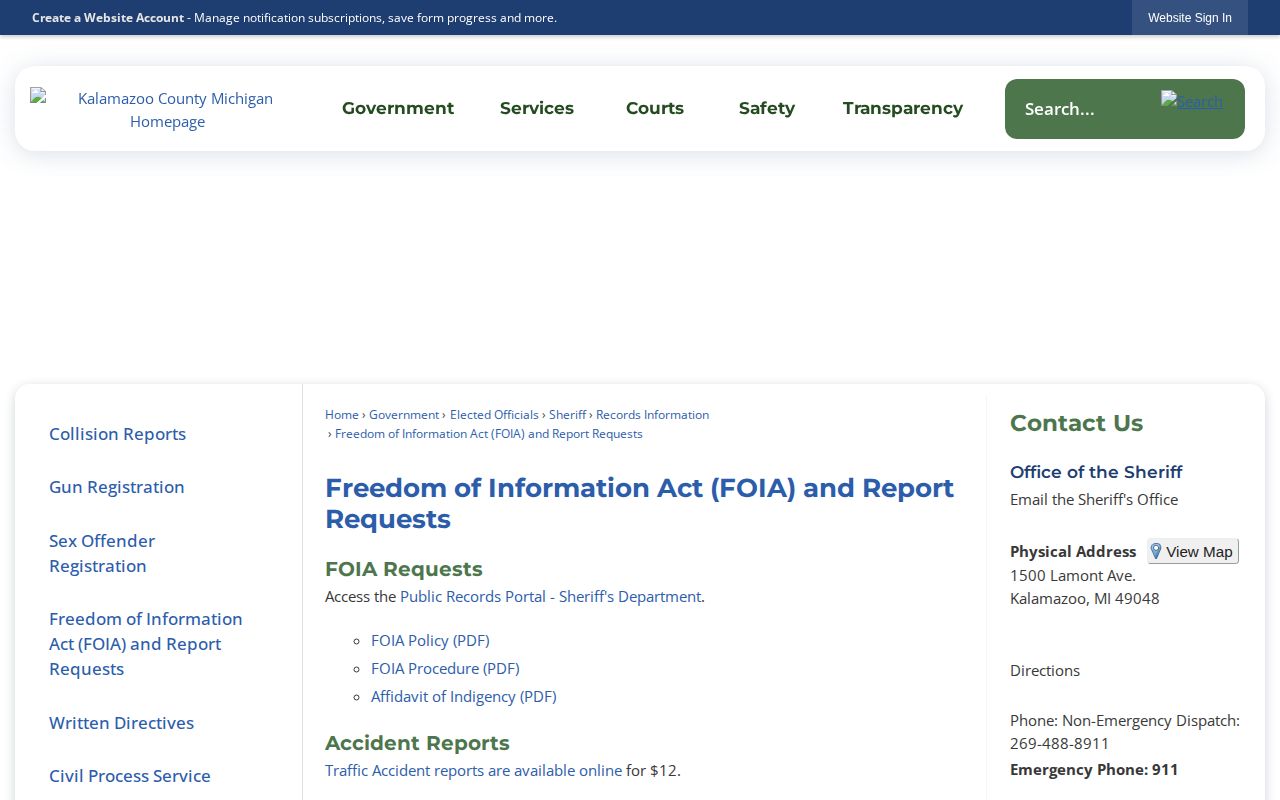
That source is the route for a sheriff-held release transaction or named booking photograph, subject to Michigan law and lawful redaction.
Kalamazoo County Release Record Law
Michigan FOIA favors access to existing public records but preserves exemptions. Juvenile information, medical facts, victim details, protected addresses, active investigative material, sealed records, and set-aside material can be restricted. Kalamazoo’s public inquiry proves some booking history remains online, but its roughly 60-day default search range is not a retention promise. Older searches may require a broader booking interval or a records request.
Set-aside relief can change public visibility. Michigan’s Setting Aside Convictions Act, MCL 780.621 and following, sets different waiting periods and exclusions. When a conviction is set aside, public court access and OTIS can change. Disappearance from a public portal may therefore be a lawful record change, not proof that no arrest, custody period, or release ever occurred.
State corrections records follow a different clock. MDOC says an ordinary discharged OTIS profile remains public for three years after discharge from supervision, unless legal relief changes it sooner. The MDOC past-records contact handles inquiries for former prisoners up to six years after release, subject to disclosure rules. Older prison history may require the Archives of Michigan, while the sentencing court keeps the judgment that created the term. These separate limits explain why the same person may disappear from OTIS but still have a court file or an agency record available by request. Search age and system scope must be checked before treating a missing online result as proof.
- Time served
- A sentence outcome based on time already spent in custody.
- Parole
- Conditional prison release while MDOC jurisdiction continues.
- Probation
- A community sentence supervised under a court order.
- Discharge
- The end of a corrections sentence or supervision term.
- Detainer
- A hold or notice from another authority that may prevent community release.
Kalamazoo County Bond Release Costs
Kalamazoo’s bond process has local details that distinguish a pending-case release from sentence completion. The KCSO Posting Bond page lists a $10 cash-only processing fee per charge for the described warrant, post-arraignment, and surety transactions. It also lists a $12 booking fee. Lobby kiosk and eXpressAccount options can add vendor charges.
Money posted for bond may be applied by the court to fines and costs. Any balance follows the county’s stated return process. These transaction charges are not FOIA fees. Most importantly, bond does not decide guilt or end the case. The person remains subject to the court’s terms and may also be directed to county pretrial supervision.
Kalamazoo County Release Funds
KCSO states that a remaining inmate account balance is issued by debit card or check at release. The public jail information does not establish an exact exit door, daily release schedule, family waiting area, clothing process, or property-pickup rule. Those operational facts should be confirmed through the jail information line at 269-383-8821.
Record corrections also follow the source. A court-derived error in OTIS should go to the sentencing court. A supervision fact should be raised with the assigned MDOC office. This avoids asking the jail to change a court judgment or asking the court to edit a current corrections assignment.
Find Kalamazoo County Released Inmates
Start with the last known system. A county arrest points to KCSO. A Michigan prison term points to OTIS. A federal prison sentence points to the BOP locator. A possible immigration transfer points to ICE. Juvenile placement must remain within the authorized Family Division process. Searching the wrong system can produce a true “no result” that says nothing about release.
- Search the official KCSO inquiry with “In Custody” unchecked and a useful booking range.
- Open the booking and read housing, disposition, disposition date, bond, and case references.
- Search both relevant Kalamazoo court levels in MiCOURT when a felony began in district court.
- Use OTIS if sentencing or transport could have moved the person into MDOC.
- Use VINE for a live status or future alert, not as a permanent archive.
- Request the release transaction when the public fields remain unclear.
The KCSO inquiry screen exposes the locally important current-custody and booking-date controls.
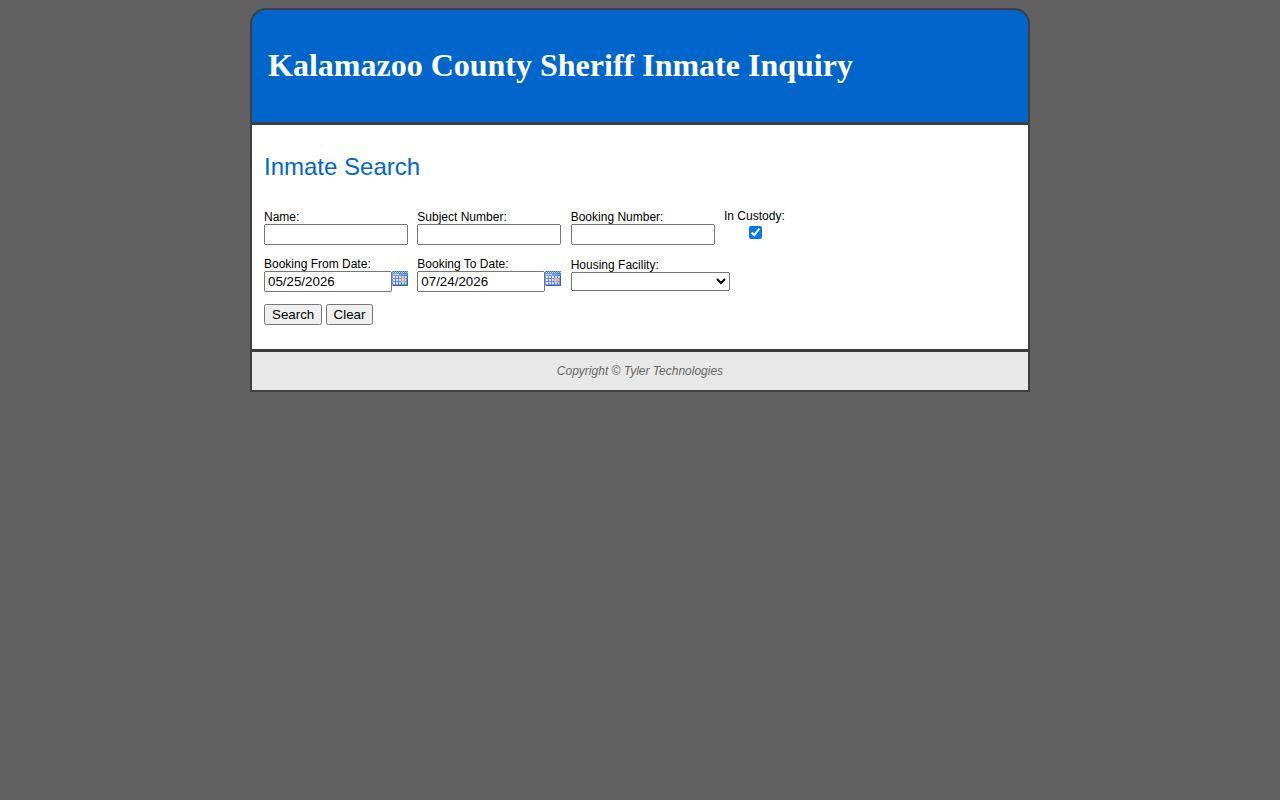
Its date fields select bookings, not releases, so each blank current row still needs a disposition and destination check.
Kalamazoo County Released Inmate OTIS
The Michigan OTIS offender search covers prisoners, parolees, probationers, and people discharged from MDOC supervision within the prior three years. It excludes county-jail-only people. Search by first and last name or six-digit MDOC number, then confirm date of birth and physical descriptors before relying on the record.
Read Status and Location before any date. “Date Paroled” supports physical prison exit with continuing supervision. “Discharged” means MDOC jurisdiction ended. Earliest Release Date is a parole-eligibility point, not a scheduled gate date. Maximum Discharge Date is the outside sentence date. A probationer may be in the community without ever having left prison because no prison term occurred.
| OTIS field | Use | Limit |
|---|---|---|
| Name or MDOC number | Find the state record | Confirm identity with other fields |
| Status and location | Shows prisoner, parole, probation, or discharge context | Not a county-jail record |
| Date Paroled | Confirms prison-to-parole transition | Supervision still continues |
| Discharge date and reason | Shows MDOC control ended | Public display usually ends after three years |
| Earliest Release Date | Shows first Board jurisdiction point | Not a release promise |
Kalamazoo County Release Court Trail
Kalamazoo criminal cases can span two courts. Eighth District Court handles misdemeanors through disposition and felony matters through the preliminary examination. Ninth Circuit Court holds the later felony disposition and sentence. A district bindover only moves the felony forward. It is not the final outcome.
Use MiCOURT Case Search with the correct court and case number. Look for bond orders, recognizance release, dismissal, judgment, jail credit, probation, MDOC commitment, discharge, or later relief. Certified proof comes from the clerk. A court order can explain why custody should change, while the sheriff or MDOC transaction confirms what physically occurred.
Kalamazoo County Release Supervision
Kalamazoo County Community Corrections began in 1990 and describes MDOC-funded local alternatives such as pretrial supervision, cognitive programs, and substance testing. The county attributes a prison commitment rate around 11 percent, compared with a state rate just under 20 percent, to its approach. Those are county-attributed program figures, not a current release count.
Community Corrections at 1421 Healy Street, Suite 2 is not a public released-person database. MDOC parole and probation operates next door in Suite 1. The shared address can cause real confusion, yet the agencies serve different legal statuses. A parolee left state prison and remains under MDOC control. A probationer has a community sentence. A pretrial participant still has an unresolved case and follows a local court order. Detailed verification steps appear under Kalamazoo County Parole / Probation.
Getting Home After Kalamazoo Release
Metro’s official route information says Route 10 Comstock serves the Kalamazoo County Sheriff’s Department and County Jail. This is a practical local travel option, not a special discharge shuttle. Service day, direction, stop, and schedule can change. Confirm the trip through Metro or Track My Bus and call 269-337-8222 when route details are unclear.
Family members should not assume a pickup place or time. KCSO has not published those details in the researched jail pages. Confirm them through the jail information line before travel, especially when a bond transaction, transfer, or court order is still being processed.
Kalamazoo County Federal Release Paths
VINE can provide county custody changes, general MDOC release alerts, and supported court events. It is a current status and notification service, not a historic certificate. A transfer alert means custody moved. Direct crime victims seeking added MDOC parole notices use the separate Crime Victim Notification Unit as well as any public VINE registration.
Federal prison releases appear in the BOP Inmate Locator for records from 1982 onward. “Released” or “Not in BOP Custody” ends the BOP custody claim, but another authority or federal supervision may remain. Federal pretrial movement is better checked through the Western District docket and U.S. Marshals district contact. Possible immigration custody is checked in ICE’s locator with the required identifiers. Kalamazoo County has no verified ICE detention contract in the reviewed sources, so an ICE transfer must not be presumed from a blank KCSO row.
| Situation | Where to look | What absence means |
|---|---|---|
| Currently in county jail | KCSO inquiry with In Custody checked | May be released, transferred, or outside the selected range |
| Past county booking | KCSO history, court, and release request | Broaden dates or request the record |
| State prison or supervision | OTIS | County-only cases and older discharges are excluded |
| Federal prison term | BOP locator and federal docket | USMS or other custody may still exist |
| Immigration custody | ICE locator and Detroit Field Office | Identifiers or processing may prevent a match |
Kalamazoo County Release Facilities
Kalamazoo’s map includes custodial facilities, supervision offices, and outside systems because each can hold the next part of a release trail. The adult jail is first. Juvenile records follow restricted Family Division routes. Community and MDOC offices document reporting status, not jail custody. State, federal, ICE, and USMS pages explain transfers beyond the county.
- Kalamazoo County Jail: county booking, release, transfer, and records route.
- Kalamazoo County Juvenile Home: authorized youth placement and release contacts.
- Kalamazoo County Office of Community Corrections: local pretrial reporting after court-approved release.
- MDOC prisons statewide: OTIS parole and discharge records for state prisoners.
- MDOC Kalamazoo parole/probation offices: local state supervision.
- Federal, ICE, and U.S. Marshals systems: separate federal custody paths.
Can a blank KCSO row prove release home? No. It proves only that the inquiry does not present current Kalamazoo County Jail housing. Read the disposition, court order, and receiving system before deciding where the person went.
Kalamazoo County Jail Release History
Historical county records described a 327-bed state-rated jail with a population that regularly exceeded 400. A jail addition opened in 2013 and helped return people who had been housed in other counties. County reporting later recorded 12,024 bookings and an average daily population of 391 in 2015. Those year-labeled figures explain why transport, overflow, and transfers are part of the Kalamazoo County release trail. They are not a present capacity certification, a count of people released today, or proof that any one blank roster row represents community release.