
U.S. Marshals Custody in Kalamazoo
The U.S. Marshals Service manages federal pretrial detention and transports people for court and placement. It can use contract beds in county or other nonfederal facilities. That arrangement means a federal detainee may appear briefly in a local jail system, move elsewhere under USMS authority, and still have no BOP record. The Western District of Michigan handles the federal court trail tied to Kalamazoo.
USMS custody is not the same as serving a designated federal prison sentence. BOP generally becomes the better public locator after federal sentencing and designation. Before that point, the court docket and the last detaining facility are more useful. The Marshals Service does not offer a public historic release locator comparable to BOP's tool.
Trace a Federal Pretrial Detainee
Begin with the federal case. A docket can identify detention hearings, release orders, conditions, remand, sentencing, and later movement into BOP custody. The last known facility may confirm current presence or departure, but a local roster ending only proves that facility no longer presents the person as housed there.
- Identify the federal district and case number. For Kalamazoo-area cases, check the Western District of Michigan.
- Search the federal docket by case number or party name and locate detention, bond, release, remand, or sentencing entries.
- Contact the last known facility when a current placement question remains. Ask whether it can confirm presence or departure.
- Use the U.S. Marshals Service Western District contact for a case-specific custody route when public sources are unclear.
- After sentencing and designation, check the BOP locator for the federal institution or later release result.
- Confirm the outcome with the actual order or agency record. Do not convert silence in one system into a release claim.
The complete Kalamazoo cross-system process on the released-inmate home page helps separate county jail, MDOC, BOP, ICE, and USMS paths when the last custodian is uncertain.
Note: A transport between contract facilities keeps federal custody in place even though the first jail roster no longer shows the person.
Why the BOP Search May Fail
The BOP locator covers Bureau custody, not every person facing a federal case. A defendant held for trial by USMS may not have reached BOP designation. A person in transport may also be between public records. Search timing, spelling, identifier errors, and processing can add more uncertainty.
| Federal stage | Best public route |
|---|---|
| Arrest and initial appearance | Federal docket, detention order, last facility, and USMS district route. |
| Pretrial detention | Court detention entries and USMS custody context; BOP may have no record. |
| Sentenced but not designated | Judgment and USMS transport trail while BOP processing is pending. |
| Serving a federal prison term | BOP locator plus the sentencing judgment. |
| Released from BOP | BOP release label and date, checked against the docket and any later custodian. |
A BOP result reading “Not in BOP Custody” is also incomplete by itself. The person may be in USMS, state, county, or immigration custody, or may be on federal supervised release. The federal docket can supply the legal transition that the brief locator label does not explain.
Kalamazoo Federal Release Court Trail
The U.S. District Court for the Western District of Michigan is the official court route for federal cases arising in the district. The docket can show an initial detention decision, bond conditions, an order of release, remand into custody, judgment, sentence, appeal, or revocation proceeding. Those entries provide legal context but do not always supply the exact moment a facility completed release.
A release order authorizes the legal path. Staff may still complete identity, hold, transport, and record checks. Another warrant or detainer can prevent community release. Conversely, a sentencing entry can move the person toward BOP designation rather than out of custody. Read the entry text and the later docket sequence.
Does a court release order prove the person walked out?
It proves the court's direction. Confirm the physical event with the detention custodian or USMS when another hold or processing step may apply.
Note: A docket supplies legal authority, while the responsible detention agency records the physical move or exit.
PACER Federal Custody Record Fields
PACER Case Locator helps locate federal court cases across districts when the court or case number is not known. After locating the case, open the district docket and look for the entries that control custody. Party names must be matched carefully because federal records can contain similar names and multiple related proceedings.
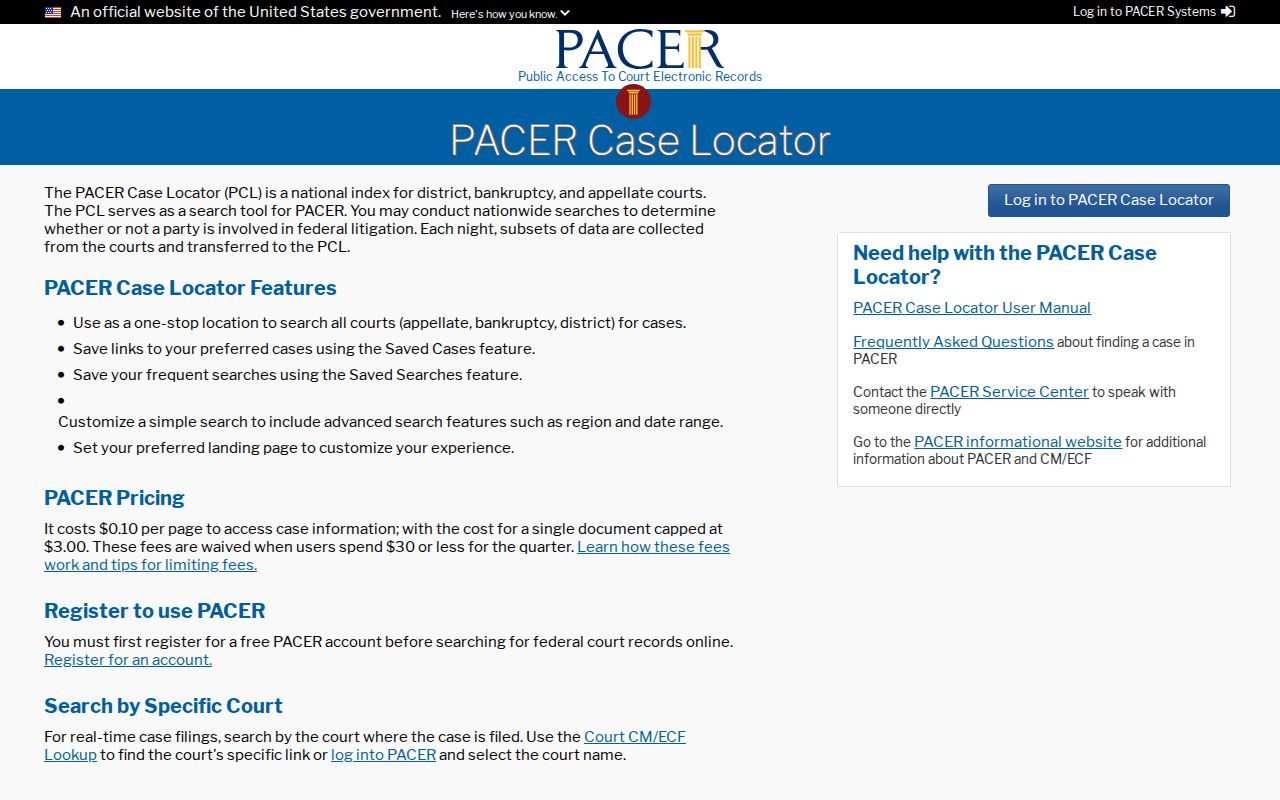
The captured PACER page demonstrates the official case-locator route. It does not disclose a current USMS placement or release without the matching docket and identity.
| Docket item | Custody meaning |
|---|---|
| Detention order | The court orders custody pending further proceedings. |
| Bond or conditions order | The court sets terms that may permit pretrial community release. |
| Release order | The court directs release, subject to other lawful holds and processing. |
| Remand | The person is returned to custody, often after a hearing or judgment. |
| Judgment | States the federal sentence and any supervised-release term. |
| Revocation entry | May document later action involving supervision and renewed custody. |
PACER is a case system, not a live jail roster. The docket explains authority and sequence. The last facility or responsible agency confirms the physical status when that fact is available.
Confirm USMS Release or Transfer
The core question is whether federal custody ended or merely moved. A transport from Kalamazoo County Jail to another contract facility is a transfer. A move after federal sentencing toward a BOP institution is also continued custody. A court-ordered pretrial release can place the person in the community under conditions, while a completed prison term can lead to supervised release.
- USMS detainee
- A person held or transported under federal Marshals authority, often before or during court proceedings.
- Contract facility
- A nonfederal jail or detention site used to house a federal detainee.
- Remand
- A court direction returning or keeping the person in custody.
- Transfer
- A move between custodians or facilities without ending legal custody.
- Supervised release
- A federal court-ordered community term, usually after imprisonment.
Use two official indicators where possible. A release order plus confirmation from the detention custodian is stronger than either alone. A BOP facility result plus the judgment supports post-sentence designation. A BOP release date plus the docket can establish the end of Bureau custody and the start or continuation of court supervision.
USMS, BOP, and ICE Boundaries
Federal agencies have different roles. USMS handles federal pretrial custody, court security, and transport. BOP operates federal prisons and publishes a locator for its current and former prisoners. ICE manages civil immigration detention and has a separate locator. A person can move between these systems, but one search does not stand in for the others.
- Use the federal prison release page after BOP designation or for a completed federal prison term.
- Use the Western District docket and USMS contact before designation or during federal pretrial detention.
- Use ICE's locator only when a supported immigration transfer or hold is part of the record.
- Use the named county or state custodian when the docket or agency record identifies that receiving system.
No official source in the research identifies Kalamazoo County Jail as an ICE detention contract facility. Do not infer an immigration event just because someone disappears from a local roster. A named transfer, detainer, or case fact should lead to the ICE route.
U.S. Marshals Records and Contact
The strongest contact depends on the question. The federal court owns its orders and docket. The last facility owns its local custody record. USMS controls its transport and detention functions, subject to release and disclosure rules. Ask for an existing record or a routing contact rather than requesting a custom legal conclusion.
U.S. Marshals Service
Western District of Michigan
Federal pretrial custody and transport route
Official district contact page
U.S. District Court
Western District of Michigan
Detention, release, judgment, and docket records
Official district court site
Include the person's full name, case number, approximate date, and last known facility when available. If the exact exit or transfer time is required, direct that question to the custodian that recorded the movement. Protected or sealed information may not be public.
Note: A narrow request tied to one case, date, and facility is easier to route than a broad custody question.