
Kalamazoo Parole and Probation
Parole follows a Michigan prison term. A parolee has left the secure prison on the date shown in the Michigan Department of Corrections record, yet remains under MDOC jurisdiction and must report as directed. Probation is a court sentence served in the community. It may begin without any prison stay, after time in the Kalamazoo County Jail, or after another court disposition. County pretrial supervision is different again. It applies while a criminal case remains unresolved and a judge has allowed the person to live in the community under stated terms.
These paths can look alike because each may involve reporting. The legal source is what separates them. OTIS, the MDOC Offender Tracking Information System, covers state prisoners, parolees, felony and certain probationers, and people discharged from state supervision within the public display period. Kalamazoo County Community Corrections handles local pretrial and program functions. The court record supplies the probation judgment or pretrial order. A county jail booking record may show that local custody ended, but it does not by itself identify the later supervision status.
| Status | How it begins | Best verification source | Meaning of release |
|---|---|---|---|
| Parole | Conditional release from an MDOC prison | OTIS status, Date Paroled, and assigned location | Out of prison but still under MDOC control |
| Probation | Court sentence in the community | OTIS and the Ninth Circuit judgment | May or may not follow time in jail |
| Pretrial supervision | Court order while a case is pending | Court order and county Community Corrections | Released from jail while the case continues |
| Discharge | Completion or termination of supervision | OTIS discharge date or an official discharge record | MDOC jurisdiction has ended |
- Parole
- Conditional community placement after a state prison term.
- Probation
- A court sentence served under rules in the community.
- Discharge
- The formal end of the agency's supervision or sentence jurisdiction.
- Absconder
- A person alleged to have stopped complying with supervision, not someone who completed it.
Verify Kalamazoo Post-Release Supervision
Start with MDOC OTIS when a Michigan felony prison, parole, or probation case is possible. OTIS does not contain people whose only custody was a county jail or city lockup. Search by a six-digit MDOC number when known, or use the person's name. Confirm the match with the available date of birth, physical details, court file, and Kalamazoo supervision location. Names alone can produce the wrong person.
The record must be read in sequence. Current Status tells whether the person is a parolee, probationer, prisoner, discharged person, or absconder. Date Paroled applies to a prison exit onto parole. Supervision Begin Date and Assigned Location describe the ongoing case. A future Supervision Discharge Date is a projected endpoint, not proof that discharge already happened. A completed discharge should be backed by the recorded discharge date or the underlying official document.
- Open OTIS and select the parolee or probationer status filter that fits the known case.
- Search by MDOC number or full name, then compare identity details before opening a result.
- Read Current Status first. Do not infer status from an address or photo.
- For parole, find Date Paroled and the assigned supervision location. For probation, compare the court judgment and supervision start.
- If a Kalamazoo office is listed, use the MDOC office directory to confirm the current contact route.
- For a court-derived sentence error, contact the sentencing court. For an assigned-supervision error, contact the listed MDOC office.
The Kalamazoo County released-inmate search paths help identify whether the person left the county jail, transferred into MDOC, or reached community release before supervision is checked.
Kalamazoo Parole Office Records
MDOC Field Operations Administration Region 8 supervises assigned state parole and probation cases in Kalamazoo County. The local office can address a supervision fact tied to its own caseload, subject to lawful access limits. It is not the place to verify a county-only booking or a juvenile placement. Search OTIS first, record the MDOC number and status, and then call the assigned office when the public entry appears wrong or needs current clarification.
MDOC Kalamazoo County Parole/Probation
1421 Healy Street, Suite 1
269-383-8972
The MDOC Region 8 directory is the official source for the Kalamazoo office. Its entry distinguishes the state supervision office from nearby county programs. Use the directory again before a visit because assignment and contact information can change.
Note: Bring the exact MDOC number or court case number when requesting a correction, since a name alone may not identify the right file.
Two Kalamazoo Supervision Suites
Healy Street contains two offices that are easy to confuse. MDOC Kalamazoo County Parole/Probation occupies Suite 1 and uses 269-383-8972. Kalamazoo County Office of Community Corrections occupies Suite 2 and uses 269-383-6434. The shared street address does not create one agency or one record system. Suite 1 covers assigned state parole and probation work. Suite 2 supports county pretrial and community programming.
A person released from Kalamazoo County Jail on a judge's pretrial order may be told to report to the county program. That person is not automatically a probationer or parolee. The county pretrial instructions say an enrolled person making a first contact should provide a full name, callback number, case number, and judge's name. That participant route is not a public released-person search. The underlying court order remains the best source for why reporting was required.
Kalamazoo County Community Corrections
1421 Healy Street, Suite 2
269-383-6434
Monday through Friday, 8 a.m. to 4 p.m.
Kalamazoo Community Release Programs
Kalamazoo County says its Community Corrections work began in 1990. The county program description identifies MDOC-funded alternatives that include pretrial supervision, cognitive programming, and substance testing. These are local case-management and reporting functions. They are not a public roster of released people, and enrollment should not be used to guess whether someone served a prison term.
The county attributes a prison commitment rate of about 11 percent, compared with a state rate just under 20 percent, to its local approach. Those are county-attributed program figures, not release totals and not a measure of current parole cases. Their value is context. They show why a Kalamazoo court record may lead to a community program even when a reader expected a prison path. Always match the program to the judgment or pretrial order.
A parolee can also use local services, but the legal supervisor remains MDOC. A probationer may have needs that overlap with county programs while still holding a distinct court sentence. Separate the support service from the authority that imposed and monitors the status.
Kalamazoo Parole Release Decisions
The Michigan Parole Board is the sole paroling authority for felony offenders committed to MDOC. Ordinary consideration begins about six months before eligibility. An interview or hearing means the Board is considering release. It does not prove that the person left prison. A grant starts more work, including placement review, detainer and adverse-information checks, sentence-time certification, final record review, and a signed parole order.
MDOC states that at least 28 days are required between a grant decision and physical release. New misconduct or another legal event can suspend that path. The practical sequence is: eligibility, Board review, grant or denial, release processing, signed order, and Date Paroled. Use the last two stages to confirm the actual transition. A proposed date should never be reported as a completed prison exit.
The MDOC parole consideration process explains why a favorable decision and a gate date are not the same event.
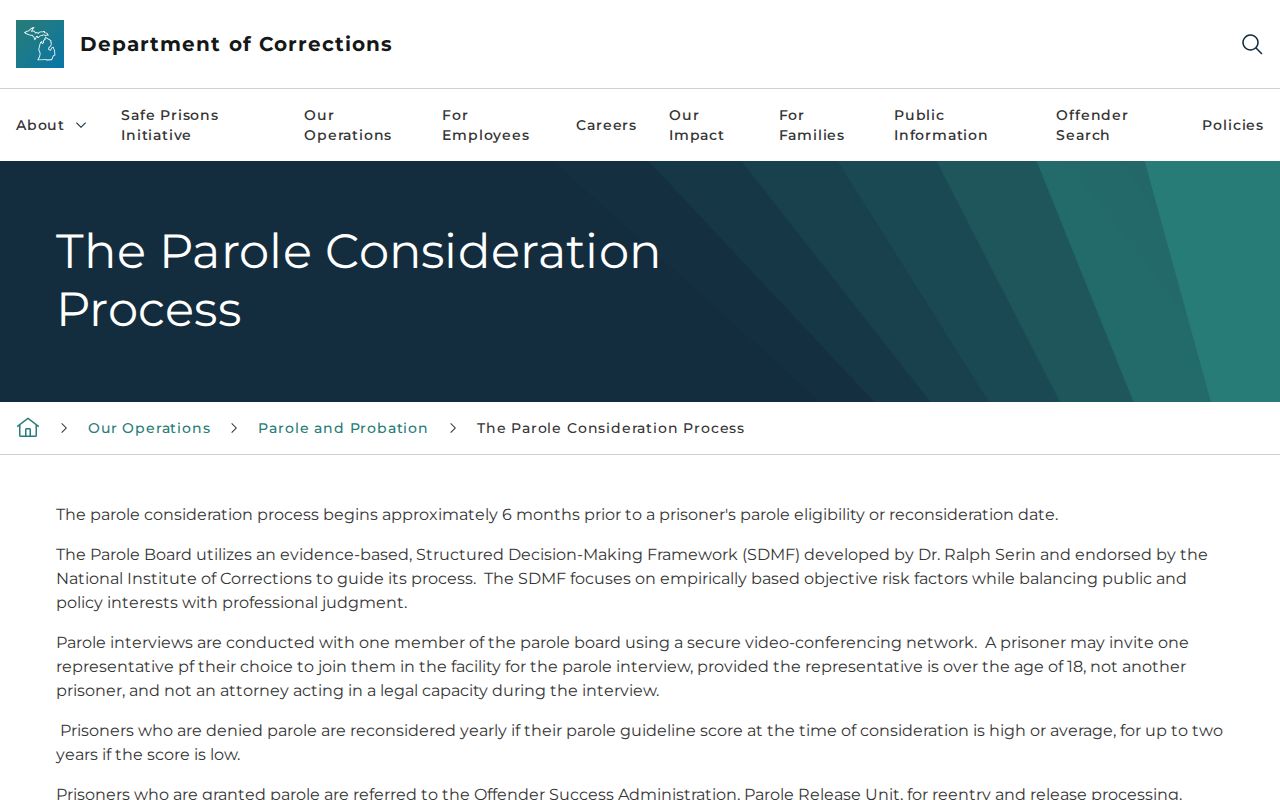
The process image reinforces that actual Kalamazoo parole release should be checked through the parole order and OTIS Date Paroled, not a hearing date alone.
Public hearing listings are narrower than many readers expect. The MDOC registration page covers scheduled lifer-law, commutation, and pardon hearings. There is no complete public calendar for every routine parole interview. MDOC also prohibits recording, photography, and screenshots of live proceedings. Aggregate reports show grants, denials, and deferrals, but no official named-person public decisions database was found.
Kalamazoo Supervision Violation Status
OTIS includes Parole Absconders and Probation Absconders filters. An absconder is a person alleged to have stopped following supervision requirements or stopped reporting. The label is not a discharge. It also does not mean the sentence ended. When a matching OTIS entry uses that term, preserve the exact wording and date rather than recasting the person as simply released.
Conditions differ by case and may address reporting, approved residence, travel, treatment, testing, contact, or other conduct. A violation allegation can result in review, a warrant, changed conditions, or a return to custody, depending on legal action. The public record may not show every detail. KCSO has a Warrants Section, but the research found no suitable county public list that combines warrants with released-person supervision status.
MDOC directs reliable location information about an absconder to law enforcement or its Absconder/Escapee Tip Line at 517-755-0855. Do not use an informal online post as status proof. A court order, OTIS record, or agency confirmation carries the relevant authority.
Note: MI-VINE may report supported custody changes, but it is not a permanent parole or probation history and should be checked against OTIS.
Kalamazoo Release Property Questions
Post-release planning often begins before the correct supervision office is known. KCSO states that a remaining inmate account balance is paid by debit card or check at release. The public jail pages do not state the physical exit, a daily release schedule, clothing or property pickup steps, or a family waiting point. Those details must not be guessed.
Call Kalamazoo County Jail information at 269-383-8821 for current release logistics. The official jail information page is the county source for that facility. The number addresses the jail event, not MDOC parole terms. Once an OTIS record lists a Kalamazoo supervision office, direct a supervision question to that assigned MDOC location. For a record error, use the source of the fact: the sentencing court handles court-derived sentence information, while the assigned MDOC office handles supervision information.
The KCSO commissary page is the source for the balance-payment method.
Kalamazoo Supervision Discharge Records
Parole or probation ends through discharge, not by the passage of a displayed future date alone. OTIS may show a supervision discharge date and reason after the event. MDOC keeps an ordinary discharged profile public for three years after discharge from supervision, unless a lawful visibility change applies sooner. After that period, the sentencing court, MDOC records process, or an archive route may hold the durable record.
A discharge is distinct from Date Paroled. Date Paroled marks the move out of secure prison onto community supervision. Discharge marks the end of MDOC jurisdiction. For a precise official record, request the discharge certificate, parole order, or other named document through the MDOC FOIA process. Michigan FOIA generally requires an initial response within five business days, subject to the permitted extension and lawful exemptions.
Michigan law also affects record visibility. A qualifying conviction set-aside can cause a public OTIS entry to be removed. Online absence may therefore reflect system scope, the three-year display period, a correction, or lawful relief. It does not prove that parole, probation, or discharge never occurred. Keep the retrieval date with any saved status and obtain the originating record when the exact legal endpoint matters.