
Kalamazoo ICE Custody Network
ICE immigration custody is a federal civil system. It is not an MDOC prison, a Kalamazoo County Jail unit, or a county parole office. The facility map includes it because a person can leave local criminal custody and enter a different federal custodian. When that happens, the county booking may become noncurrent while federal detention continues somewhere outside Kalamazoo County.
No official source reviewed for this project identifies Kalamazoo County Jail as a current ICE detention contract facility. That absence must be stated plainly. It does not rule out an ICE detainer, a transfer after local release processing, or custody at another location. A detainer is a request or notice from another authority concerning custody. Its presence and effect should be confirmed from the record rather than assumed from the person's name or case type.
The ICE Online Detainee Locator System, commonly called ODLS, is the correct public first step when the facts support possible immigration detention. Michigan falls within the ICE Detroit Field Office route. Neither source turns a missing result into proof of release.
Kalamazoo Immigration Transfer Paths
A Kalamazoo County booking can end in several ways. The person may post bond, receive a court-ordered release, complete a local sentence, transfer to another Michigan jail, enter MDOC after a felony judgment, move into federal criminal custody, or enter immigration custody. The blank In Custody and Housing Facility cells in the KCSO inquiry only show that the local system no longer presents the booking as current. They do not identify the next destination.
Read the detailed booking disposition, court docket, and any transfer information that is lawfully available. A district or circuit order may explain why the local jail authority ended. If an immigration hold or transfer appears, use ODLS next. If the case is federal criminal rather than civil immigration, the U.S. Marshals Service and federal docket may control before BOP takes custody. Matching the legal system prevents an unproductive search in the wrong locator.
| Last known event | Next official source | What it can establish |
|---|---|---|
| Local booking no longer current | KCSO detail and court order | Booking disposition and possible authority for the change |
| Possible immigration transfer | ICE ODLS and Detroit Field Office | Current or recent ICE detention path |
| Federal criminal transport | Federal docket and USMS district | Pretrial or transport custody context |
| State prison commitment | MDOC OTIS | Michigan prison, parole, or discharge status |
| Community release | KCSO release transaction and court record | Local release event and legal authority |
Search Kalamazoo ICE Custody
Open the ICE Online Detainee Locator and choose the search method supported by the known identifiers. The strongest route uses the person's A-number and country of birth. An A-number is the immigration identification number assigned in the federal system. ODLS also offers a biographical route using a full name, date of birth, and country of birth.
Enter names exactly, then test supported spelling variations if necessary. Hyphens, multiple family names, transliteration, and name order can affect a result. Compare the returned identity carefully. A same-name result is not enough. Very recent admissions, some young people, incomplete identifiers, and processing delay can require direct agency help.
- Confirm that the case facts point to immigration custody rather than MDOC, BOP, or another county.
- Search ODLS with the A-number and country of birth when both are known.
- If the number is unavailable, use the exact biographical name, date of birth, and country of birth.
- Compare every available identity detail before relying on a location result.
- Record the retrieval date and exact status language because the locator is current or recent, not permanent history.
- If no result appears, check the identifiers and use the Detroit Field Office route rather than declaring release.
ODLS is not a county criminal docket. It does not replace the KCSO booking detail or the Kalamazoo court order. Use those records to explain how local custody ended, then use the federal source to check whether immigration detention followed.
Missing Kalamazoo ICE Results
No result can have several explanations. The spelling may differ, the A-number may be incomplete, the person may be too recently admitted for the public system, or ICE may not be the custodian. ODLS is not designed as a durable history of every past detention and release. A person who once appeared may not remain searchable as a permanent public record.
Start again with the last confirmed record. In the KCSO Inmate Inquiry, uncheck the current-only box and open the relevant booking history. Its date fields concern booking, not release. Review the disposition and case reference. Then search the Eighth District or Ninth Circuit record through MiCOURT. A commitment, bond order, dismissal, or transfer-related event can narrow the next source.
If the facts still point to ICE, contact the regional field-office route. If they point to USMS, use the federal docket. If a state felony judgment commits the person to MDOC, allow for reception processing and search OTIS. Absence from a mismatched system proves nothing.
Note: Preserve the exact date and wording of every official result so later changes can be compared without overstating what the earlier screen meant.
Detroit ICE Release Contact
The ICE Detroit Field Office is the documented regional route for Michigan. Use its current official contact instructions when ODLS does not resolve a case that has a sound immigration-custody basis. The office may require identity or case information and may limit what it can disclose. No local Kalamazoo ICE office or detention-site contact was verified in the research.
ICE Detroit Field Office
Michigan regional immigration-custody contact
Official field-office page
The official field-office page below is the successful manifest source for the regional contact path.
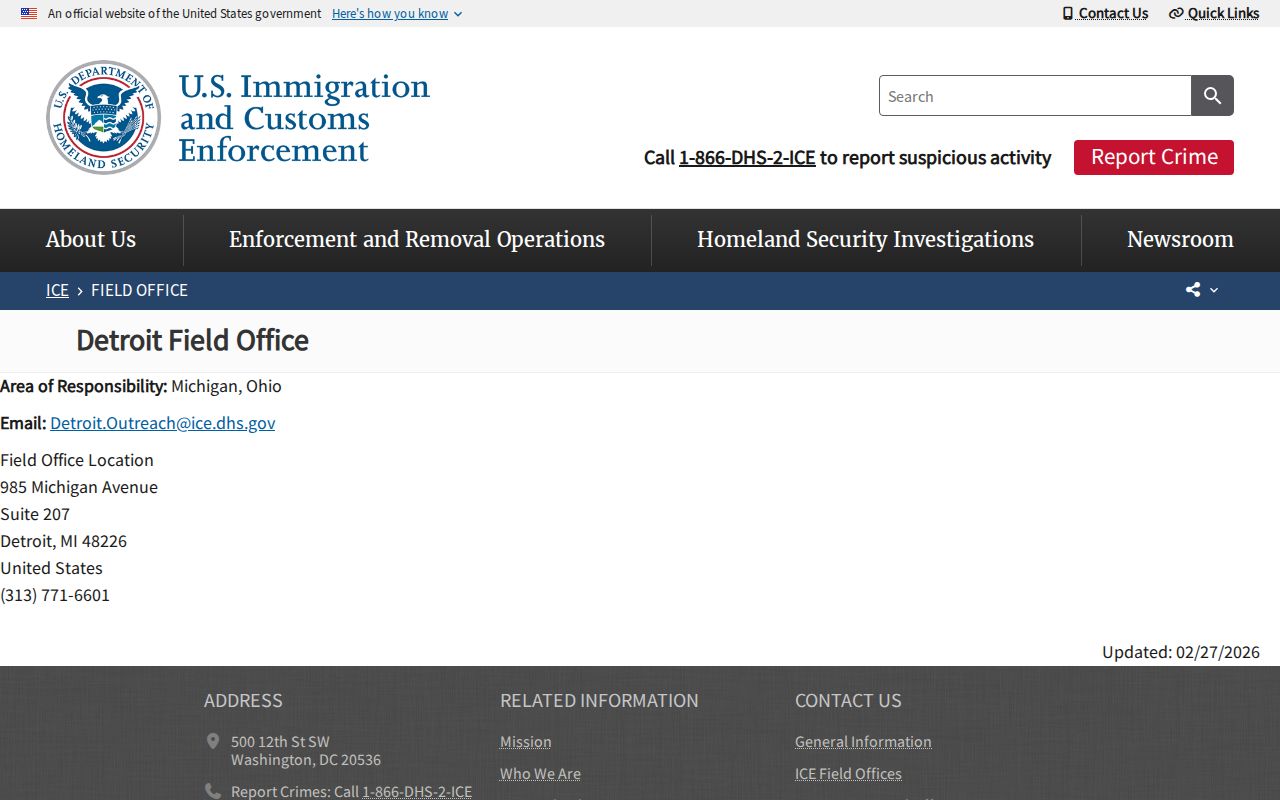
The image connects a Kalamazoo inquiry to the correct federal region without implying that the Detroit office is the detention location or record of release.
Have the full legal name, date of birth, country of birth, A-number if known, and the last confirmed custodian ready. Do not send unnecessary personal data through an unverified channel. Begin from the official federal page each time.
Kalamazoo ICE Release Records
ODLS can help locate present or recent detention, but it is not the durable record of how a Kalamazoo jail booking ended. For the county side, ask KCSO for the booking and release or transfer summary tied to the exact episode. The sheriff records page provides the official request route, and KCSO Records can be called at 269-385-6191 before a written request to ask whether a record is publicly releasable.
A focused request can identify the person, booking number, approximate booking date, and case number, then ask for the actual release or transfer date and time, disposition, releasing authority, and destination or receiving agency if nonexempt. Request segregable nonexempt portions if part of the record is withheld. Juvenile, medical, protected-address, investigatory, or other restricted material may not be available.
Michigan FOIA generally provides five business days for an initial grant, denial, partial response, or permitted extension notice. It does not govern federal ICE records, and it does not guarantee immediate production. For the federal side, follow the current ICE record-request directions appropriate to the document sought. A county record and a federal record answer different parts of the custody chain.
Confirm Kalamazoo ICE Release
A physical release from one agency should be described at that level only. KCSO may confirm that county jail custody ended. ICE may confirm whether federal civil detention is current or recent. A court order may explain the legal action. None of those sources, alone, proves that no other agency assumed custody.
The strongest confirmation pairs independent official facts. For example, a county transfer record plus an ODLS location supports a move into immigration detention. A later federal release document plus the relevant proceeding may support release from ICE custody. A blank KCSO row plus no ODLS result is not the same quality of proof because both screens have scope and timing limits.
When the destination remains unclear, work from the chronology: last KCSO booking, court authority, receiving agency, current locator, and actual release document. The Kalamazoo County released-inmate search covers the wider county, state, federal, and court routes when the correct custodian is not yet known.
Kalamazoo Federal Custody Boundaries
ICE, BOP, and USMS are separate federal paths. ICE handles civil immigration custody. BOP holds people serving federal prison terms and provides a locator that may show Released or Not in BOP Custody. USMS manages federal pretrial and transport custody and has no equivalent public historic release locator. A person can move among systems without appearing in all three at once.
County and state tools differ too. The KCSO inquiry covers Kalamazoo jail bookings. OTIS covers MDOC prisoners, parolees, probationers, and recent discharges, not county-only or ICE detainees. VINE can provide supported custody-change alerts, but it is notification infrastructure rather than a permanent archive. Choosing the right tool is part of the evidence.
- ICE ODLS
- Current or recent federal civil immigration detention lookup.
- BOP Locator
- Federal prison custody and certain release-result information.
- USMS and federal docket
- Federal pretrial, transport, and case-disposition route.
- KCSO Inquiry
- Local adult county booking and current-housing history.
- MDOC OTIS
- Michigan prison and state community-supervision record.