
Kalamazoo Supervision Office Role
MDOC Field Operations Administration Region 8 operates the Kalamazoo parole and probation office. It is a noncustodial state office. People do not serve jail or prison time there, and they are not physically released from its doors as part of a custody discharge. The location matters after release because an MDOC parolee may be assigned to report there. It also serves assigned felony and certain probation cases.
Parole follows a state prison term. Date Paroled in OTIS marks the move out of secure prison and onto community supervision. Probation is a court sentence that can begin without a prison stay, after county jail time, or after another disposition. Both statuses can lead to a Kalamazoo office assignment, but only parole proves a prior MDOC prison release.
County pretrial supervision is a third path. A judge may release a person from Kalamazoo County Jail while the case remains pending and direct that person to county Community Corrections. That reporting duty is neither parole nor probation. The court order, not the shared Healy Street address, defines the status.
| Status | Legal source | Meaning of office assignment |
|---|---|---|
| Parole | MDOC prison release and Parole Board action | Ongoing state control after prison exit |
| Probation | Circuit court sentence | Community sentence supervised by MDOC |
| Pretrial supervision | Pending-case court order | County reporting while charges remain unresolved |
| Discharge | Completed state supervision record | MDOC jurisdiction has ended |
Verify Kalamazoo MDOC Supervision
The correct public lookup is MDOC OTIS. It covers state prisoners, parolees, felony and certain probationers, and ordinary discharged profiles during the three years after discharge from supervision. It does not cover a person whose only sentence was Kalamazoo County Jail, and it does not serve as a public list of everyone who visits the Healy Street office.
Search by the six-digit MDOC number when known. A name search can also work, but a name alone is not enough to confirm identity. Compare the available birth date, physical descriptors, court file, and location. Read Current Status before dates. Then check Date Paroled, Supervision Begin Date, Assigned Location, and Supervision Discharge Date as applicable.
- Open OTIS and choose the prisoner, parolee, probationer, or absconder category supported by the known case.
- Search by MDOC number or full name, then compare identity details before opening the record.
- Read Current Status and Location before deciding whether the person is in prison or in the community.
- For parole, find Date Paroled and the assigned supervision location. For probation, compare the state entry with the court judgment.
- Treat a future supervision-discharge date as a projected endpoint, not as a completed discharge.
- Contact the Kalamazoo office only after the public entry identifies it as the assigned supervision route.
The wider Kalamazoo County released-inmate search helps when the last custodian is unclear or the county booking may have ended by transfer.
Kalamazoo MDOC Office Contact
Use the local office for an assigned supervision issue, a location question tied to its own caseload, or a supervision-specific correction. Staff may limit what they disclose. The office is not a general county booking-record line, and it cannot replace the sentencing court when the disputed fact came from a judgment.
MDOC Kalamazoo County Parole/Probation
1421 Healy Street, Suite 1
269-383-8972
The MDOC Region 8 directory is the official source for the Kalamazoo office location and telephone route.
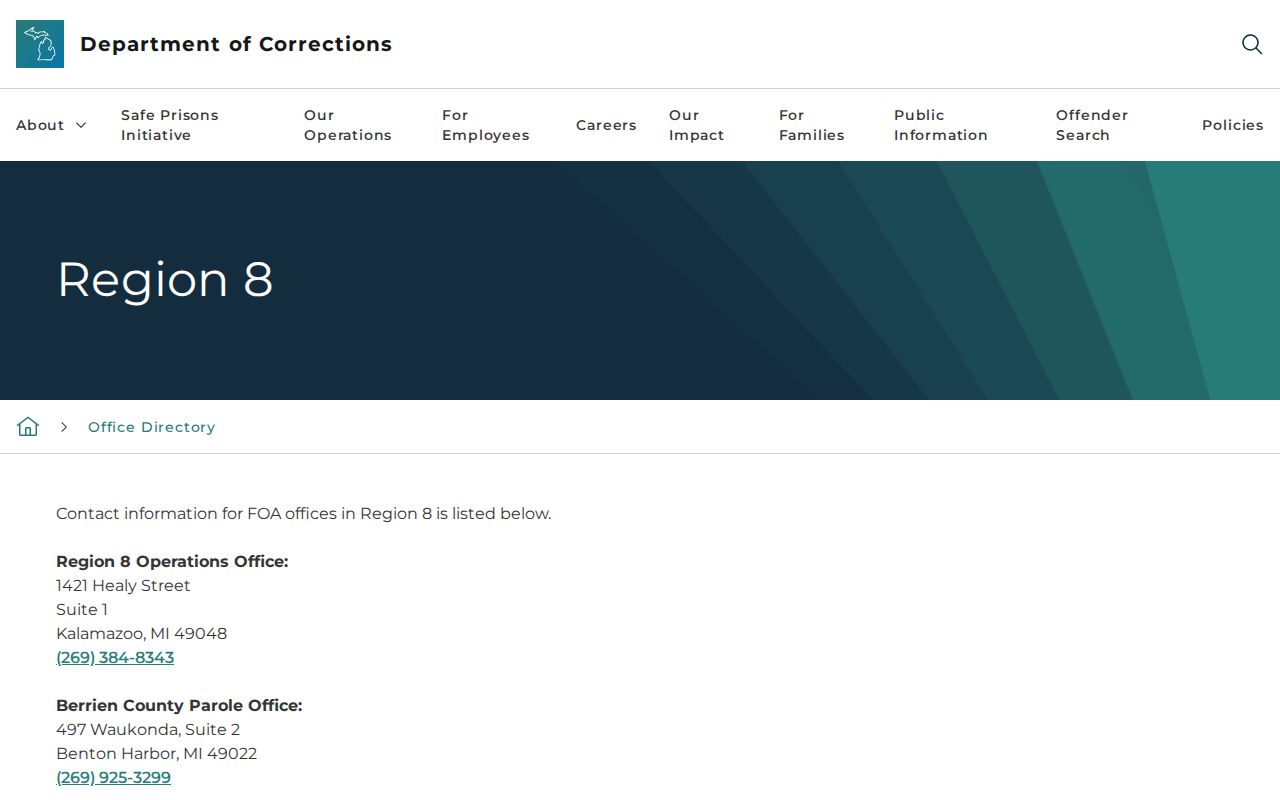
The directory image identifies the state office route without implying that the directory itself verifies a named person's parole or probation status.
Have the MDOC number, full name, and relevant court case number ready. For immediate safety or a known absconder location, use the law-enforcement or MDOC tip route rather than an ordinary records inquiry.
Two Kalamazoo Healy Street Offices
The most distinctive local detail is the two-suite arrangement. MDOC Kalamazoo County Parole/Probation occupies Suite 1 at 1421 Healy Street and uses 269-383-8972. Kalamazoo County Office of Community Corrections occupies Suite 2 at the same street address and uses 269-383-6434. The neighboring offices serve different populations under different authorities.
Suite 1 is the state supervision route. Suite 2 supports county pretrial and community programs. A prison parolee reports under MDOC authority. A person released before trial reports under the judge's order and county instructions. A probationer reports under the circuit-court sentence. Never identify the status from the suite address alone.
The county pretrial page explains the participant contact route. An enrolled person making contact is instructed to provide a full name, callback number, case number, and judge's name. That intake path is not a public search for released people.
Note: Confirm the suite number before calling or visiting because the shared address does not create a shared database or legal status.
Kalamazoo Community Corrections Context
Kalamazoo County states that Community Corrections began in 1990. Its program description identifies MDOC-funded alternatives such as pretrial supervision, cognitive programming, and substance testing. The county attributes a prison commitment rate of about 11 percent, compared with a state rate just under 20 percent, to its local approach.
Those figures are county-attributed program context. They are not current release counts, office caseload totals, or proof that a particular person avoided prison. Their value is that they explain why a Kalamazoo case may lead to a county program even when readers expect a state prison or parole path. The judgment or pretrial order controls the actual outcome.
The funding connection also does not merge the agencies. MDOC can fund or coordinate local alternatives while the county office retains its distinct function. For an individual lookup, OTIS identifies state supervision, and the court identifies pretrial or sentencing authority.
Kalamazoo Parole Release Process
The Michigan Parole Board is the sole paroling authority for felony offenders committed to MDOC. Ordinary consideration begins about six months before eligibility. An interview, public notice, or hearing is a step in consideration, not proof of physical release. Most routine cases do not appear on a complete public statewide hearing calendar.
A grant remains conditional while MDOC checks placement, detainers, adverse information, sentence-time certification, final records, and the signed parole order. MDOC states that at least 28 days are required between a grant and physical release. New misconduct or a legal development can suspend the proposed path.
The MDOC parole process explains those stages. For actual exit, use Date Paroled in OTIS plus the parole order when available. A discharge date means state jurisdiction later ended. It should not be confused with the earlier prison-release date.
Public hearing registration applies to limited categories such as lifer-law, commutation, and pardon proceedings. Aggregate Board reports show grants, denials, deferrals, and reasons by category, but no official named-person public decision database was located. A narrowly framed records request may seek the relevant action subject to exemptions.
Kalamazoo Absconder Status Records
OTIS includes Parole Absconders and Probation Absconders filters. An absconder is a person alleged to have stopped complying with supervision or reporting. The status does not mean discharge or successful completion. It also should not be reduced to the broad claim that the person is merely released.
MDOC directs reliable information about a known location to local law enforcement or its Absconder/Escapee Tip Line at 517-755-0855. KCSO maintains a warrants function, but no suitable public Kalamazoo list was found that combines warrants with parole and probation status. Do not rely on crowdsourced claims.
MI-VINE may supply supported custody-change notifications for participating records. It is not a complete supervision history. A current OTIS record, a court warrant or order, and confirmation from the assigned office are the proper sources for the status.
Kalamazoo Release Handoff Questions
A person arriving at the MDOC office after release may still need to resolve property, funds, identification, transport, or reporting details. KCSO states that a remaining inmate account balance is issued by debit card or check at jail release. The county jail pages do not publish the physical exit, release-hour schedule, clothing or property pickup process, or family waiting point.
Call Kalamazoo County Jail information at 269-383-8821 for the jail handoff. That office answers a different question from MDOC supervision. Once OTIS lists the Healy Street office, direct reporting and supervision questions to Suite 1. If the person was placed on county pretrial supervision instead, use the court order and Suite 2 participant route.
Record corrections follow the source of the fact. MDOC says court-derived OTIS errors must go to the sentencing court. A supervision fact such as the assigned office or absconder status goes to the supervising parole or probation office. That separation avoids asking jail staff to amend an MDOC entry or asking MDOC to rewrite a court judgment.
Kalamazoo Supervision Record Requests
OTIS is a public status tool, not the complete parole or probation file. When the exact document matters, identify it. A parole order, discharge certificate, basic information sheet, sentence-time calculation, or Board action answers a more precise question than a broad request for all records.
The MDOC FOIA process accepts requests for releasable state correctional records. Michigan's public-record rules allow exemptions and redaction, and a custodian can require permitted fees. The public PENPACK route is not an ordinary shortcut because MDOC restricts that certified packet to recognized authorities for official work.
The successful manifest image below comes from the Michigan Attorney General FOIA guidance, which describes the state public-record framework used to understand a response.
The guidance supports a focused document request and does not promise disclosure of protected supervision details.
Michigan FOIA generally gives a public body five business days for its initial grant, denial, partial response, or permitted extension notice. That is not always the production date. Ask for segregable nonexempt portions when a record contains protected information.
Kalamazoo Supervision Discharge
Discharge is the formal end of MDOC supervision or sentence jurisdiction. It is different from parole. A parolee is physically outside prison but remains under MDOC control. OTIS may show a completed discharge date and reason, while a future Supervision Discharge Date remains only an expected endpoint until the event occurs.
Ordinary discharged records remain public in OTIS for three years after discharge from supervision. After that, use MDOC records, the sentencing court, or an archive route as appropriate. A lawful set-aside can remove a public entry sooner. Online absence may therefore reflect scope, timing, correction, or legal relief rather than proof that supervision never existed.
The Kalamazoo County parole and probation record page explains the difference between parole, probation, pretrial supervision, absconder status, and discharge in more detail. Preserve the retrieval date with every OTIS result and obtain the originating document when the legal endpoint must be proved.