
MDOC Statewide Release Scope
The Michigan Department of Corrections Offender Tracking Information System, known as OTIS, covers prisoners, parolees, and probationers under MDOC supervision. It also keeps ordinary public discharged profiles for three years after discharge from supervision. State prison and supervision records are statewide. They are not limited to the county in which the criminal case began.
OTIS expressly excludes county-jail-only people, city-lockup prisoners, people sentenced only to a local jail term, and people not sentenced into MDOC jurisdiction. A Kalamazoo County detainee can disappear from the KCSO roster because the sheriff transported that person to state prison. OTIS may begin showing the new record after reception and processing. That county exit is a transfer, not community release.
Search MDOC Statewide Release Records
Start at OTIS and choose “Start Offender Search.” Search by last and first name or a six-digit MDOC number. Name variants and aliases can help when spelling has changed. Open the likely profile and compare date of birth, physical descriptors, photograph when available, sentence, county, and court file number before relying on the status.
- Search the name or MDOC number. Use status filters only when the expected state status is known.
- Confirm identity with the profile details and Kalamazoo County court information. Do not rely on the name alone.
- Read Current Status and Location first. A prison location, parole status, probation status, and discharge status mean different things.
- For prison exit, locate Date Paroled. For completed state control, read Discharge Date and Discharge Reason.
- Compare the Ninth Circuit judgment when a sentence, county, or court-derived fact appears wrong.
- Request the underlying MDOC document when a parole order, discharge certificate, or time computation is needed.
A photograph can aid identity checks, but it is a corrections image rather than a Kalamazoo arrest photo. MDOC notes that a photo may be missing for an older record or someone not yet photographed in the electronic system. The photo cannot replace the status and date fields.
Read MDOC Release Status
“Parolee” and “Discharged” are not synonyms. A parolee has left the secure prison, but MDOC custody and supervision continue in the community. Date Paroled marks the state-prison exit and status transition. A discharged person has reached the end of MDOC jurisdiction. The profile can show a discharge date and reason during the public display period.
A probationer is also in the community, but probation is a court sentence and may never follow a state-prison term. An absconder status means an alleged failure to comply with parole or probation. It does not mean successful completion, lawful discharge, or freedom from state control. Read the full status instead of treating any community location as the end of the case.
| OTIS field or status | What it establishes | What it does not establish |
|---|---|---|
| Prisoner and facility | Current MDOC prison placement | A county-jail release to the community |
| Date Paroled | Physical exit from prison to parole | End of MDOC supervision |
| Parolee | Community status under MDOC control | Completed sentence jurisdiction |
| Discharged | MDOC jurisdiction has ended | The precise earlier county jail exit |
| Absconder | Alleged supervision noncompliance | Discharge or sentence completion |
Note: A future supervision-discharge date is a scheduled endpoint, not proof that state supervision has already ended.
MDOC Statewide Release Dates
OTIS does not provide one guaranteed projected gate date. Earliest Release Date, also described as the Parole Board Jurisdiction Date, is generally when the Board first gains authority after the controlling minimum is served. It is an eligibility milestone. The Board can deny release and reconsider later. Maximum Discharge Date is the lawful outside sentence date, subject to the law and calculations that govern the sentence.
Michigan uses indeterminate sentencing for most prison cases, with a judicial minimum and a statutory maximum. For covered truth-in-sentencing cases, the MDOC truth-in-sentencing source says the person must serve 100 percent of the judicial minimum in prison before parole consideration. Michigan should not be described with a generic 85 percent rule. Legacy sentences may involve older sentence-reduction law, so the offense date and governing sentence rules matter.
A parole grant is also not same-day release. MDOC states that at least 28 days are required between a grant and physical release. Placement review, detainer checks, time certification, final records work, and a signed parole order must still be completed. New misconduct or other legal developments can affect the plan. Date Paroled is the stronger public field for confirming that prison exit actually occurred.
- Earliest Release Date
- The first parole-jurisdiction point for the controlling sentence, not a promise of release.
- Maximum Discharge Date
- The outside sentence date if release does not occur earlier under lawful authority.
- Date Paroled
- The recorded transition from secure prison to parole supervision.
- Discharge Date
- The date MDOC sentence or supervision jurisdiction ended.
Request MDOC Statewide Release Records
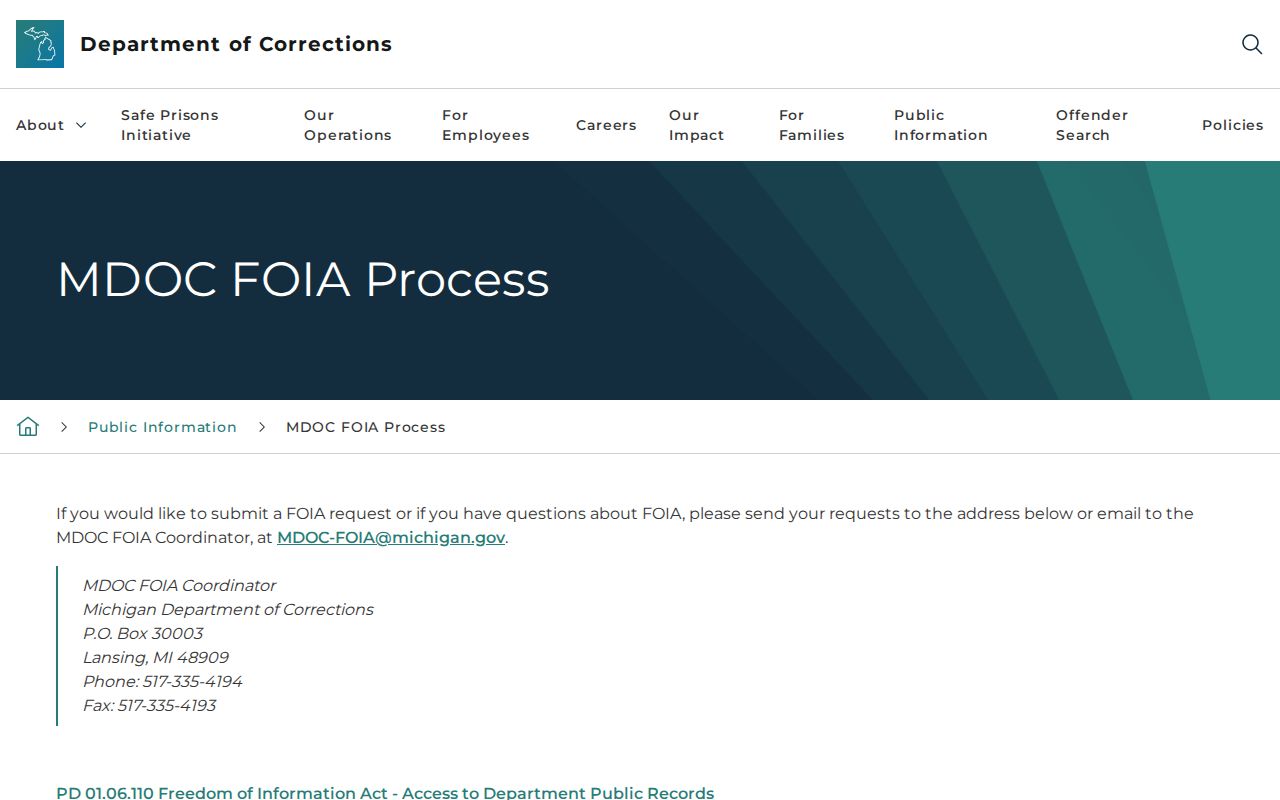
The MDOC FOIA process is the document route for a basic information sheet, discharge certificate, parole order and actual date, sentence-time calculation, certification, or releasable photograph. Requests can be sent to MDOC-FOIA@michigan.gov or mailed to MDOC FOIA Coordinator, P.O. Box 30003, Lansing, MI 48909. The published phone is 517-335-4194 and fax is 517-335-4193.
Name the person and MDOC number when known. Identify the specific document and time period. Asking for a parole order, discharge certificate, or time calculation is more precise than asking staff to assemble a broad history. Protected material can be withheld, but a requester may seek segregable nonexempt portions.
The successful manifest capture comes from the official MDOC state record request route.
For past prisoners, MDOC lists MDOC-Records_Retention@michigan.gov for records up to six years post-release. That route extends beyond OTIS’s ordinary three-year discharged-profile display, though access limits still apply. Older prison history may require the Archives of Michigan. MDOC says its computer records date to about 1980.
MDOC Statewide Records Contacts
MDOC general information can help with OTIS and status navigation. The published number is 517-335-1426, with hours Monday through Friday from 8 a.m. to 5 p.m. Eastern, and the email is CorrectionsInfo@michigan.gov. A supervision-specific error belongs with the assigned field office. A court-derived conviction or sentence error belongs with the sentencing court.
Michigan Department of Corrections
General information:
517-335-1426
CorrectionsInfo@michigan.gov
Monday through Friday, 8 a.m. to 5 p.m. Eastern
FOIA Coordinator:
P.O. Box 30003
Lansing, MI 48909
517-335-4194
MDOC-FOIA@michigan.gov
MDOC’s restricted PENPACK is not an ordinary public release-record shortcut. The agency describes that certified packet as available to recognized criminal-justice authorities for official business. Public requesters should identify the releasable documents they need instead of claiming access to the whole packet.
Kalamazoo MDOC Release Trail
A Kalamazoo felony case can begin in Eighth District Court and then move to Ninth Circuit Court for final felony disposition and sentence. A district bindover is not the final judgment. When the circuit judgment commits the person to MDOC, disappearance from the county jail roster reflects movement to state custody. The judgment and later OTIS record should align on the case and sentence.
After parole, an OTIS Kalamazoo supervision location may show that the person reports locally. MDOC Kalamazoo Parole/Probation is at 1421 Healy Street, Suite 1, and uses 269-383-8972. That field office is not a prison. It handles community supervision. County Community Corrections next door in Suite 2 serves a different local program population.
The Kalamazoo parole and probation office page covers local reporting and status correction. Use OTIS to confirm the statewide record first. The local office may address its assigned cases, but it may withhold protected supervision detail.
Older MDOC Discharge Records
A person who is no longer visible in OTIS was not necessarily never imprisoned or discharged. Ordinary public discharged records remain for three years after discharge from supervision. A lawful set-aside can also change public visibility. Online absence must be read against those limits.
For an older Kalamazoo County case, begin with MiCOURT Case Search, check the Ninth Circuit judgment and later orders, then use MDOC past-records or FOIA channels. A discharge certificate is stronger proof of completed MDOC authority than a saved search result. When the question is only whether the person left prison for parole, Date Paroled and the parole order answer a different, earlier event.