
Kalamazoo Release Dates Explained
Michigan records do not provide one universal projected date. For a person held at Kalamazoo County Jail before trial, an exit depends on a bond posting, personal recognizance order, dismissal, transfer, or another court action. The live legal position can change. A booked person may also have another case, warrant, sentence, or detainer. A detainer is a request or legal hold from another authority. It can prevent community release even after the local case would otherwise permit an exit.
A sentenced county prisoner has a date based on the judgment, sentence start, jail credit, concurrent or consecutive terms, sheriff-awarded credit, and any holds. State prisoners follow MDOC records. OTIS presents an Earliest Release Date and a Maximum Discharge Date for many indeterminate sentences. Indeterminate means the judgment has a minimum and a maximum term. The Parole Board may consider release after jurisdiction begins, but it may deny or defer release.
A date should always be saved with the day it was retrieved. Sentence credits, amended judgments, appeals, misconduct, detainers, and data corrections can change what the system shows. A stale screenshot should not override a current official record.
Find a Kalamazoo Release Date
Begin with the last known custodian. The KCSO Inmate Inquiry covers Kalamazoo County Jail bookings. Its date filters are booking dates, not release dates, and its detail page has no clearly labeled projected exit field. For a county sentence, the Ninth Circuit or Eighth District judgment and KCSO calculation are the sound sources. For an unresolved case, check the current bond order and docket, but do not convert a hearing date into a promised jail exit.
Use MDOC OTIS when the person is serving a state prison sentence. OTIS does not cover people sentenced only to a county jail. Search by six-digit MDOC number when known, or by name. Confirm identity before reading sentence dates. The status and location fields show whether the person is a prisoner, parolee, probationer, or discharged from MDOC jurisdiction.
- Identify whether the person is in county jail, MDOC prison, federal custody, or another system.
- For a Kalamazoo jail case, open the sheriff inquiry and the correct court docket. Read the booking and judgment together.
- For an MDOC case, search OTIS and confirm the identity, current status, location, and controlling sentence.
- Read Earliest Release Date and Maximum Discharge Date by their exact labels. Do not call either a guaranteed gate date.
- Check for a Board grant, detainer, amended judgment, consecutive term, or other event that changes the timeline.
- Confirm physical exit through Date Paroled, a signed parole order, a KCSO release transaction, or an official discharge record.
For a named-person release trail that crosses jail, court, and state systems, the Kalamazoo County released-inmate lookup explains how to corroborate two official sources without equating transfer with community release.
Kalamazoo MDOC Release Date Fields
OTIS date vocabulary is precise. The Earliest Release Date, sometimes described in MDOC material as the Parole Board Jurisdiction Date, generally marks the first date on which the Board gains authority after the controlling minimum and applicable legacy credits. It is not a grant. The Maximum Discharge Date is the outside sentence endpoint if parole does not occur first, subject to the law and credit rules that apply to that sentence.
Actual parole can fall between those endpoints. The Board must decide that release meets the statutory standard, and MDOC must finish placement and record processing. A parolee has physically left prison but remains under MDOC jurisdiction. OTIS Date Paroled marks that change. A discharged person has reached the end of MDOC jurisdiction, which is a different and often later event.
| OTIS field | What it means | What it does not prove |
|---|---|---|
| Status and Location | Current MDOC category and assigned place or office | A future release date by itself |
| Earliest Release Date | First parole-jurisdiction or eligibility point in the controlling calculation | That parole was granted |
| Maximum Discharge Date | Lawful outside sentence date if release does not occur earlier | That no later lawful recalculation is possible |
| Date Paroled | Transition out of secure prison onto parole | End of MDOC supervision |
| Discharge Date | End of MDOC sentence or supervision jurisdiction | The original county jail exit time |
The MDOC FAQ explains these fields and the limits of public OTIS records.
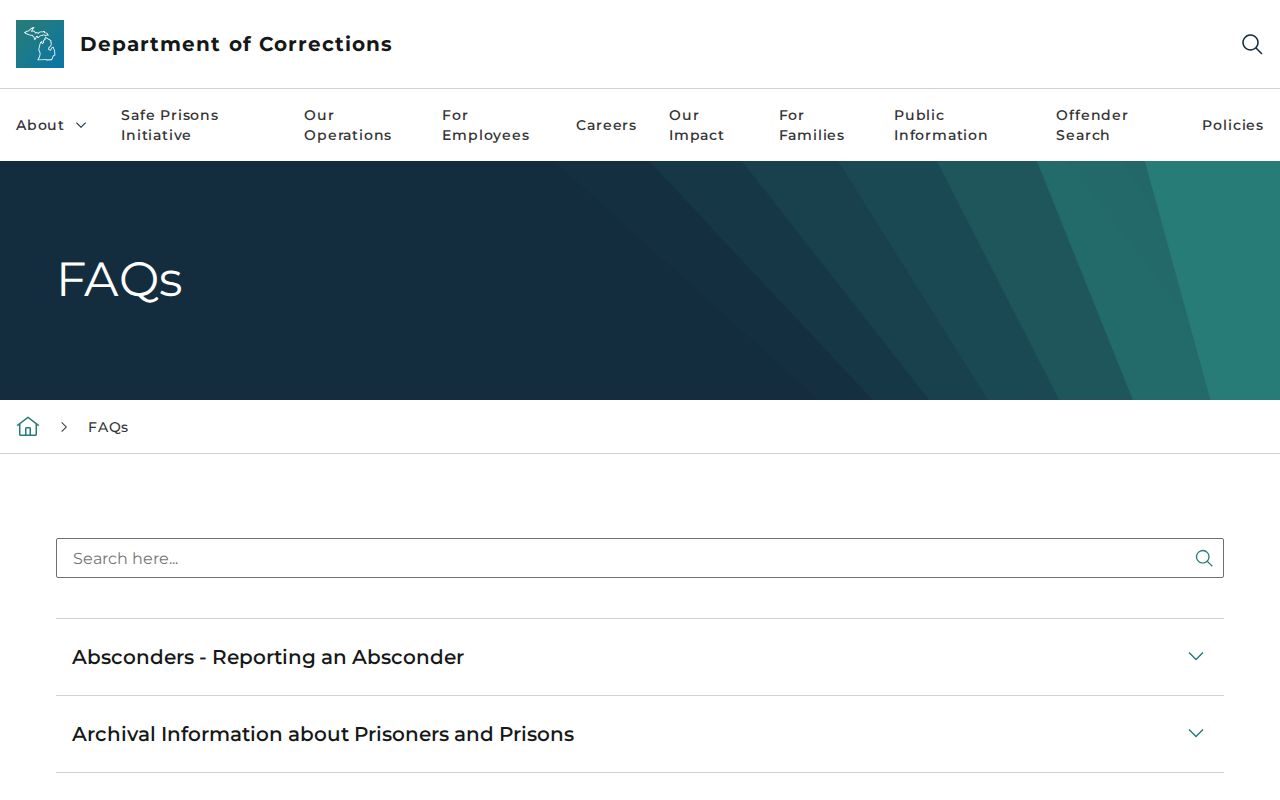
The guidance supports reading the label attached to each date rather than collapsing eligibility, parole, and discharge into one projected date.
Kalamazoo County Release Credit Split
Kalamazoo's county and state calculations follow different rules. For a sentenced county prisoner, MCL 51.282 permits one day of sentence reduction for each six days when the prisoner complies with jail rules. The sheriff may forfeit or restore that allowance. MCL 51.283 addresses posted jail rules and administration of the credit. The statute does not turn a pretrial booking into a fixed sentence, and it does not erase another warrant or hold.
Covered Michigan state prisoners face truth in sentencing. MDOC says they must serve 100 percent of the judicial minimum in prison before parole consideration. Good-time or disciplinary credits do not reduce that covered minimum. This is not the often repeated federal-style claim that a Michigan prisoner serves about 85 percent. Offense date and sentence law still matter because older or legacy sentences can involve MCL 800.33 credit rules.
The MDOC truth-in-sentencing explanation states the state-prison rule and its covered offense-date framework.
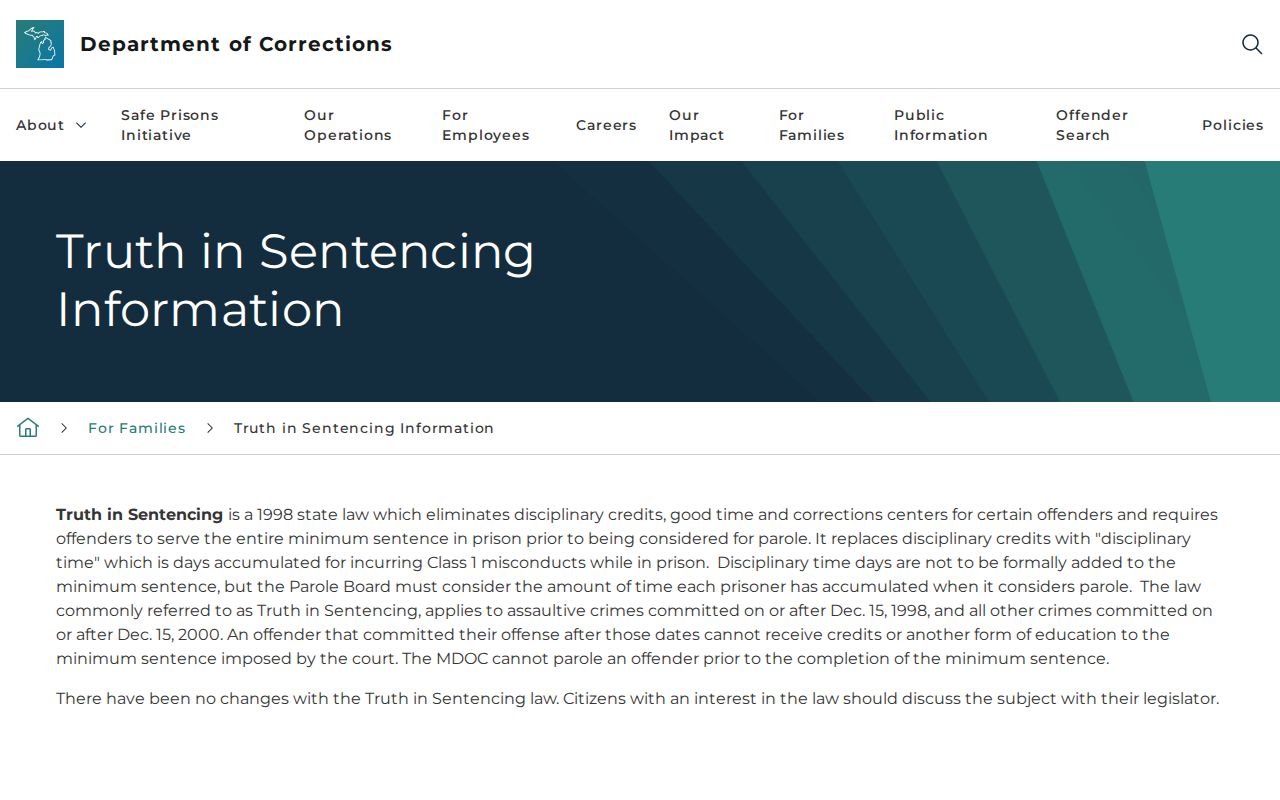
The state source confirms why a county one-for-six calculation cannot be imported into an MDOC prison sentence.
- Judicial minimum
- The minimum prison term set in the judgment before ordinary parole jurisdiction.
- Maximum term
- The statutory outside term shown in the sentence calculation.
- Jail credit
- Credit recognized for qualifying time already spent in custody.
- Consecutive terms
- Sentences served one after another rather than at the same time.
Note: The sentence judgment, offense date, and custodian must be known before any credit rule can be applied with care.
Kalamazoo Pretrial Release Timing
A pretrial detainee usually has no computed sentence-completion date. The immediate questions are whether bond may be posted, whether a judge ordered personal recognizance, whether another court entered a hold, and whether all booking-release tasks are complete. “Posted Bond” in a KCSO detail can support the reason a booking ended, but the disposition date is not a sheriff-certified physical release time.
Kalamazoo criminal cases can span two courts. The Eighth District Criminal Division handles misdemeanors through disposition and felony matters through preliminary examination. A felony bindover is not the final judgment. The Ninth Circuit Court holds the felony disposition and sentence. Search MiCOURT under both levels when the case path calls for it, then obtain the actual order from the clerk when exact legal authority matters.
A dismissal of one charge may not result in immediate release if another case, sentence, warrant, or detainer remains. A commitment to MDOC means the county jail episode ends by transfer. Allow for state reception and processing before expecting an OTIS record. The first OTIS Earliest Release Date is not the date of the county-to-state transport.
Why Kalamazoo Release Dates Change
Release calculations are records of current legal and administrative facts. They can change when those facts change. The cause may come from a court, the sheriff, another custodian, or MDOC. Read a revised date with the updated judgment or transaction when possible. A number without its label and retrieval date lacks the context needed for a sound conclusion.
| Change | Possible effect | Confirmation source |
|---|---|---|
| Corrected jail or sentence credit | Moves the computed endpoint | Judgment, time certification, or records office |
| Amended judgment or appeal | Changes the controlling term or legal authority | Sentencing court docket and signed order |
| Consecutive-sentence ruling | Requires terms to run one after another | Judgment and MDOC calculation |
| Misconduct or forfeited credit | Can delay a lawful date under the applicable regime | Sheriff or MDOC time record |
| Detainer or warrant | May cause transfer or continued custody | Holding agency and court record |
| Parole grant, denial, or deferral | Changes the possible date within the sentence window | Board action, parole order, and OTIS |
| Data correction | Replaces an inaccurate public field | Sentencing court or assigned MDOC office |
A court-derived OTIS error should be directed to the sentencing court. A supervision fact, such as an assigned location or absconder status, goes to the supervising MDOC office. MDOC updates its record when the authoritative source supports the change.
Kalamazoo Parole Release Timing
Parole consideration commonly begins about six months before eligibility. That start point is not an early release promise. The Board may interview, seek more information, grant, deny, or defer. MCL 791.234 sets the core jurisdiction framework, while MCL 791.233 requires the Board's public-safety assurance before release.
Even after a grant, MDOC says at least 28 days are required before physical release. Staff must review placement, detainers, adverse information, time certification, final records, and the parole order. New misconduct or a legal change may interrupt the process. The proposed date in a grant should therefore be treated as conditional.
The reliable end of the sequence is Date Paroled in OTIS plus the parole order or related record. The person is then outside prison but still under MDOC supervision. The Kalamazoo County parole and probation page explains how to verify the assigned office and distinguish later discharge.
Confirm Kalamazoo Inmate Release Dates
For Kalamazoo County Jail, call the jail information line at 269-383-8821 when the exact physical event matters. KCSO Records at 269-385-6191 can help identify whether a booking or release record is releasable before a written request. Ask for the actual release or transfer date and time, release disposition, authority, destination if disclosable, and booking number. A focused request is easier to route than a broad demand.
For MDOC, request a basic information sheet, time calculation or certification, parole order, or discharge certificate through the MDOC records process. Michigan FOIA generally provides five business days for the initial grant, denial, partial response, or permitted extension notice. That response deadline is not always the production date.
VINE can send a supported release or transfer alert, but it is notification infrastructure rather than the permanent record. An alert saying “transferred” means custody moved. Even a release notice from one agency does not rule out immediate custody by another. Preserve the alert time, then confirm with the contributing jail, MDOC, or court.
Note: The strongest proof pairs the physical-release transaction with the court order or sentence record that authorized it.